
Understanding the Terminology: V2L, V2H, and Bidirectional Flow
Evaluating exportable power specs requires understanding the technical distinctions between basic onboard outlets and true bidirectional energy flow. While both systems convert direct current (DC) from a battery pack or generator-alternator into alternating current (AC) for tools and appliances, their integration levels vary significantly:
1. Vehicle-to-Load (V2L) & Onboard Bed Outlets
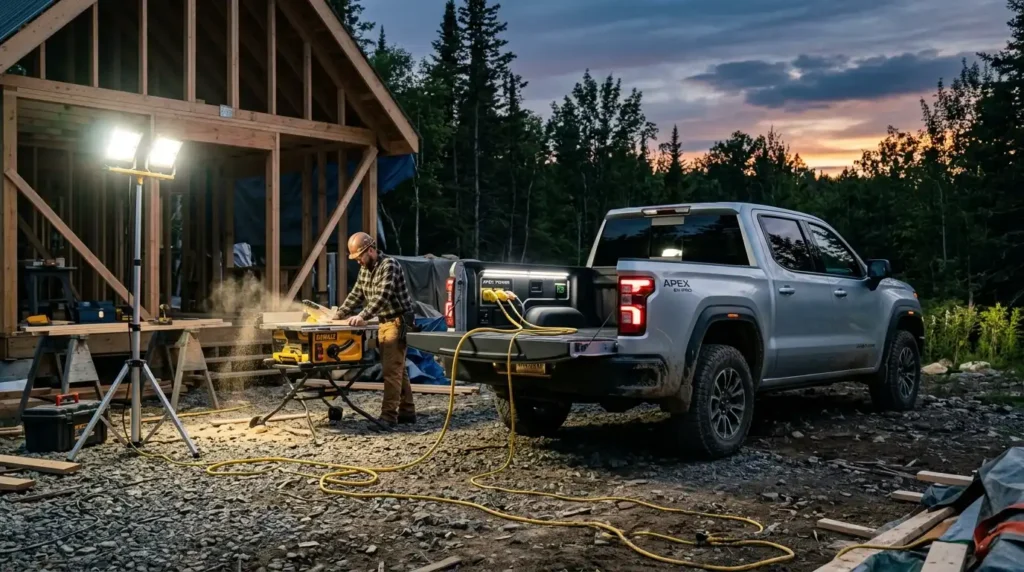
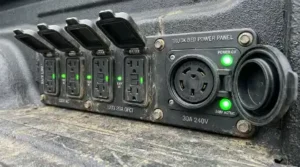 Vehicle-to-Load systems supply electricity directly through onboard AC outlets located inside the truck cab, front trunk (frunk), or bed wall. These integrated outlets operate at standard household voltages (120V) or heavy-duty industrial voltages (240V). They allow operators to plug tools, compressors, lights, or camping gear directly into the truck without external transfer switches.
2. Vehicle-to-Home (V2H) Bidirectional Charging
Vehicle-to-Home technology enables two-way energy transfer through a specialized wall-mounted home charger and home integration system. During normal operations, grid electricity flows into the truck’s high-voltage traction battery. During a severe storm or power grid outage, the bidirectional inverter reverses this flow, drawing stored energy from the truck battery back into the home’s electrical panel to power residential circuits automatically.
3. Vehicle-to-Grid (V2G) Integration
Vehicle-to-Grid expands bidirectional capability to public utility networks. Through V2G protocols, fleet operators and private truck owners can export stored battery power back to local utility grids during peak demand hours, earning financial energy credits or offsetting localized peak pricing surcharges.
Brand-by-Brand Comparison: Onboard Power Systems in 2026
Automakers have taken distinct architectural approaches to turning full-size and heavy-duty pickups into mobile power generators. Maximum export wattage, output voltages, and engine reliance vary across the segment:
Ford: Pro Power Onboard
Ford continues to set benchmark standards across both hybrid and fully electric lineups. The gas-hybrid Ford F-150 PowerBoost utilizes an integrated generator-starter motor alongside a lithium-ion battery pack, automatically cycling the gas engine to maintain steady power generation indefinitely as long as gas remains in the tank. On the battery-electric side, the F-150 Lightning relies entirely on its high-capacity battery pack.
- 2.0 kW & 2.4 kW Systems: Standard across gas and mid-tier hybrid setups, offering multiple 120V/20A outlets suitable for charging cordless tool batteries, running halogen lights, or operating small hand tools.
- 7.2 kW System: Available on 3.5L PowerBoost Hybrid trims, adding a dedicated 240V/30A NEMA L6-30R outlet to the bed wall. This configuration simultaneously powers heavy-duty air compressors, miter saws, and TiG welders.
- 9.6 kW System: Standard on higher-tier electric models, supplying up to 9,600 watts of combined exportable power across 11 distinct outlets, including the frunk, cab, and bed.
General Motors: GM Energy & PowerBase Export
General Motors leverages its Ultium EV platform across the Chevrolet Silverado EV, GMC Sierra EV, and commercial Work Truck variants. By combining high-capacity traction batteries with GM Energy’s home integration hardware, GM pickups offer some of the highest single-vehicle power outputs on the market.
- Up to 10.2 kW Onboard Export: GM’s PowerBase system provides up to 10.2 kW of total off-board AC power via bed-mounted 120V and 240V outlets, easily powering entire commercial construction framing crews.
- 5 to 21 Days of Home Backup: Equipped with large-capacity battery packs, a fully charged Silverado EV paired with a V2H enablement kit can support standard residential energy needs for several days during prolonged power outages.
Ram Trucks: Power Export & Dual-Power Architecture
Ram addresses power generation through both the fully electric Ram 1500 REV and the extended-range Ramcharger. The Ramcharger features an onboard 3.6L V6 gas engine dedicated exclusively to powering an onboard generator, which charges the battery on the fly to supply uninterrupted exportable power without range anxiety.
- Flexible Output Configurations: Delivering up to 7.2 kW in the truck bed and an available 4.8 kW panel in the front trunk, Ram models allow independent circuit balancing for high-draw tools and sensitive electronics.
Commercial Job-Site Advantages for Contractors and Fleets
For fleet managers and independent tradespeople, integrating trucks with high-capacity power outlets delivers immediate operational efficiencies beyond simply eliminating portable gas generators:
- Reduced Equipment Payload & Bed Space: Leaving a standalone 7,000-watt generator at the shop frees up valuable payload capacity and bed floor area for materials, lockable toolboxes, and equipment trailers.
- Lower Operating & Maintenance Costs: Small four-stroke gas generators require frequent oil changes, spark plug replacements, carburetor cleaning, and dedicated fuel storage. In contrast, truck-integrated power systems utilize the vehicle’s primary, highly regulated powertrain or battery management system.
- Silent Job-Site Operation: Electric and hybrid trucks operating in generator mode run quietly. This allows residential contractors to start work earlier in noise-restricted neighborhoods without violating municipal noise ordinances.
- Regulated, Clean Sine-Wave Power: Modern truck-based inverters output clean, true sine-wave AC power. This protects sensitive electronics—such as laptop diagnostic computers, battery charging stations, and digital measuring tools—from voltage spikes common in cheap portable generators.
For detailed safety procedures regarding temporary power connections on commercial job sites, consult the official OSHA Safety Standards for Wiring Design and Protection.
Addressing Battery Longevity and Energy Management
A common concern among prospective truck buyers is whether using a vehicle as a stationary generator accelerates battery degradation or leaves the truck stranded with a depleted battery.
Automakers address this through smart software safeguards embedded in the vehicle’s central touchscreen interface:
- Reserve Charge Limits: Drivers can set a minimum battery threshold (e.g., 20% or 50 miles of driving range). Once export power draws the battery down to that limit, the system automatically shuts off the outlets or fires up the internal combustion engine on hybrid models to maintain the reserve.
- Thermal Management Safeguards: Advanced liquid-cooling systems actively regulate battery and inverter temperatures during sustained high-wattage exports, protecting lithium-ion cells from heat-induced degradation.
- Optimized Discharge Cycles: Supplying steady 120V or 240V power imposes a relatively light, continuous discharge rate compared to the heavy current draws required during hard highway acceleration or heavy towing, minimizing battery stress.
The New Standard for Truck Utility

The transition toward trucks as mobile power generators represents one of the most practical innovations in modern automotive design. By transforming the pickup truck from a simple transport vehicle into an active mobile energy station, manufacturers have delivered real-world value to contractors, outdoor adventurers, and homeowners alike.
Whether you require a reliable 7.2 kW system to run power tools on a new build or a full V2H setup to protect your family during grid blackouts, selecting a truck with robust power export capabilities ensures your vehicle works for you even when parked.