
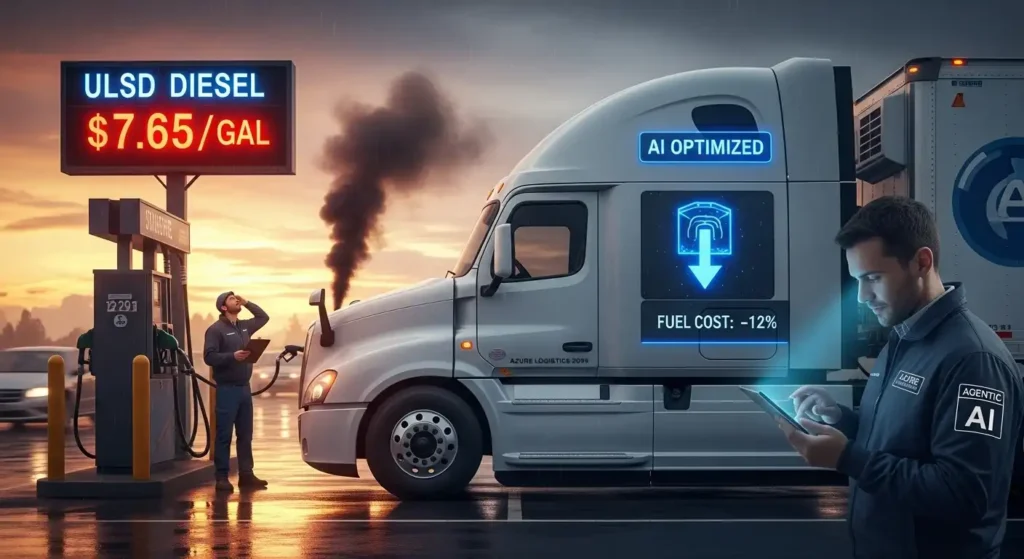
As we cross the threshold into the second week of April 2026, the American trucking industry is grappling with a volatile economic landscape that few predicted at the start of the year. The primary driver of this anxiety is the “April Spike“—a sudden and aggressive surge in diesel prices that has seen the national average climb to $5.63 per gallon, with certain regions in California and the Northeast reporting prices as high as $7.75. For an industry that operates on razor-thin margins, this is not just a seasonal fluctuation; it is a structural crisis. However, where there is pressure, there is innovation. On trucks4review.com, we are tracking how the most successful fleets are utilizing 2026 trucking industry trends—specifically Agentic AI and Mixed-Energy logistics—to turn a fuel crisis into a competitive advantage.
The Anatomy of the April 2026 Fuel Crisis
 To understand the current pivot, we must first analyze the “why” behind the numbers. The April 2026 spike is the result of a “Triple Threat” in the global energy market. First, geopolitical instability in key refining hubs has reduced the global output of ultra-low sulfur diesel (ULSD). Second, the “Spring Thaw” in the Midwest has triggered a massive uptick in agricultural and construction demand, straining domestic supply chains. Finally, the 2026 carbon-tax adjustments in several “Green Corridor” states have added a significant premium to traditional fossil fuels.
For a standard Class 8 long-haul truck, which may consume 20,000 to 30,000 gallons of fuel annually, a $1.50 per gallon increase translates to an unplanned $30,000 to $45,000 hit to the bottom line per unit. In this environment, “business as usual” is a recipe for insolvency. This has accelerated the adoption of technology that was previously considered “futuristic” but is now essential for daily operations.
Trend 1: The Move to Agentic AI and Edge Computing
The most significant shift in 2026 is the evolution from simple telematics to Agentic AI. In previous years, fleet management software simply reported data—showing where a truck was and how much fuel it had used. Today, AI “agents” integrated into the truck’s Electronic Control Unit (ECU) are making real-time decisions. This is edge computing at its finest. These systems don’t just alert a manager that a truck is idling too long; they actively adjust engine parameters, gear-shifting patterns, and even climate control settings to shave off every possible micro-drop of wasted fuel.
One of the most impressive applications we’ve reviewed this year is the AI-Terrain Predictive Controller. By utilizing high-resolution topographical data and real-time weather feeds, the AI can anticipate a grade change five miles ahead. It may decide to build momentum slightly before a hill or utilize “eco-roll” technology on a descent, functions that even the most veteran drivers cannot execute with 100% consistency over a 10-hour shift. Data from early April shows that fleets using these AI agents are seeing a 6.5% to 9% improvement in MPG compared to traditional cruise control systems.
Trend 2: Predictive Maintenance as a Profit Center
When diesel is expensive, downtime is deadly. Every hour a truck sits in a bay is an hour it isn’t earning back its fuel costs. In 2026, Predictive Maintenance (PdM) has moved from a “luxury feature” to a core profit center. Modern trucks are now equipped with acoustic sensors that “listen” to the harmonic frequencies of wheel bearings and turbochargers. AI models can detect the specific “whine” of a bearing that is 500 miles away from failure.
By scheduling a “surgical” repair during a mandatory driver rest period, fleet managers are avoiding the catastrophic expense of a roadside breakdown. In the 2026 market, a roadside tow and emergency repair can cost upwards of $4,000—not including the loss of cargo reputation. As we have discussed in our racing-focused content on the New England Truck Series, mechanical resilience is the foundation of any winning strategy, whether on the track or the interstate.
Trend 3: The Reality of Mixed-Energy Fleet Management
Perhaps the most complex of the 2026 trucking industry trends is the rise of the Mixed-Energy fleet. Many fleets are no longer “all-diesel.” Instead, they are a patchwork of technologies: Diesel for long-haul, Battery Electric (BEV) for last-mile delivery, and the newly emerging Hydrogen Internal Combustion (H2-ICE) for regional heavy-duty routes. Managing this diversity is a logistical nightmare without the right tools.
This April, we’ve seen a surge in “Universal Energy Cards.” These cards allow a driver to pull into a multi-modal station and pay for diesel, hydrogen, or high-speed megawatt charging (MCS) on a single account. This integration is critical for maintaining “flow.” If a fleet manager has to manage three different payment and tracking systems for three different fuel types, the administrative overhead eats the savings. Software that can consolidate these “Energy Silos” into a single dashboard is the “holy grail” of 2026 logistics.
Safety and Liability in the Autonomous Age
As trucks become more automated to save fuel (via drafting and optimized throttle control), the legal landscape is shifting. In Los Angeles and San Francisco, we are seeing new challenges regarding who is responsible when an automated system makes an error. Is it the driver “monitoring” the system, or the software developer? This is why we closely monitor the latest truck liability updates to ensure our readers understand the risks that come with high-tech efficiency. Safety isn’t just about avoiding crashes; it’s about protecting the business from the massive litigation costs associated with emerging tech.
Technical Spotlight: The 2027 Prototype Tease
 While April 2026 is painful, the industry is already looking toward the 2027 model year. Manufacturers are responding to high fuel prices with radical aerodynamic designs. We are seeing “Active Aero” trailer tails that deploy automatically at 45 MPH and retract for low-speed maneuvering. We are also seeing the return of the “small-block” high-efficiency diesel engine—units that are smaller in displacement but utilize twin-turbocharging and high-pressure common-rail injection to match the torque of the “big-bore” engines of the past while using 15% less fuel.
For those looking for historical context on these shifts, our sister site Butte County California provides an excellent look at how roadway safety and engine regulations have evolved in the Golden State, often serving as a harbinger for national changes.
Conclusion: The “New Normal” for the American Road
The April 2026 Diesel Spike is a harsh reminder that the trucking industry remains at the mercy of global energy markets. However, the pivot to AI and mixed-energy strategies shows that the industry is more resilient than ever. The fleets that survive and thrive through this decade will be those that treat data as their most important fuel. By embracing predictive maintenance, agentic AI, and diverse energy platforms, the American trucker is proving that while the price of the road may go up, the drive toward innovation is unstoppable.
Check back with Trucks4Review next week as we release our exclusive head-to-head comparison of the 2026 Hydrogen Class 8 prototypes versus the legendary Cummins X15 platforms.